Quick Read:
- Limitations of mammograms include: late detection, overtreatment of DCIS, false positives, and reduced accuracy in dense breast tissue.
- Safe and accurate breast cancer testing includes: Galleri, SonoCine AWBUS, thermography, and PerfeQTion Imaging.
- Safe and accurate monitoring testing includes: Onconomics Plus RGCC Test and Signatera.
For decades, women have been told that mammograms are the gold standard. And while they may have a place in certain situations, they are far from the only option…and in many cases, not the safest or most effective tool available. If you’re here, you’re likely looking for a more proactive, personalized, safer, and root-cause approach to your breast health.
And you have landed on just the right blog!
Below are several prevention and testing options to empower you to make confident, informed decisions on your healing journey.
Important note: No single test will ever be 100% accurate and all-encompassing. Also, always involve your physicians in deciding what tests are best for you.
Why Mammograms May Not Be the Best Option
Before we dive into better options, let’s address the pink elephant in the room. Mammograms have long been promoted as the primary screening tool, but they come with several limitations:
- Radiation exposure, which accumulates over time (Study [1])
Breast compression, which can be uncomfortable and potentially may stimulate cancer cells to grow or spread. - Reduced accuracy in dense breast tissue, which affects about 45% of women (Discover how to decrease dense breasts here [2])
- False positives and overdiagnosis, leading to unnecessary stress and procedures
- Overdiagnosis and overtreatment of DCIS, potentially leading to actual cancer (Learn more via this blog post [3])
- Super late detection, they may not detect tumors until 5–8 years after the tumor has already started developing
Even more importantly, mammograms are designed to detect structural changes (such as tumors), not functional changes (such as inflammation) that occur years before cancer develops. In other words, by the time something shows up on a mammogram, the imbalance has often been present for quite some time. That’s why a preventative, whole-body testing strategy and action plan is essential.
Start at the Root: Functional & Inflammatory Testing
Cancer doesn’t develop overnight. It’s often the result of chronic inflammation, toxicity, stress, nutrient deficiencies, and metabolic imbalances.
That’s why one of the most important first steps is looking at internal terrain markers, including:
- hs-CRP (high-sensitivity C-reactive protein): a key marker of systemic inflammation
- LDH (lactate dehydrogenase): associated with tissue damage and metabolic stress
- ESR (erythrocyte sedimentation rate): another inflammation indicator
- Homocysteine: linked to methylation, cardiovascular health, and cellular stress
These markers help paint a picture of what’s happening beneath the surface, often long before disease is detectable through imaging. To uncover more info on the connection between inflammation and cancer, please review this blog post [4].
Advanced & Accurate Early Detection Tests
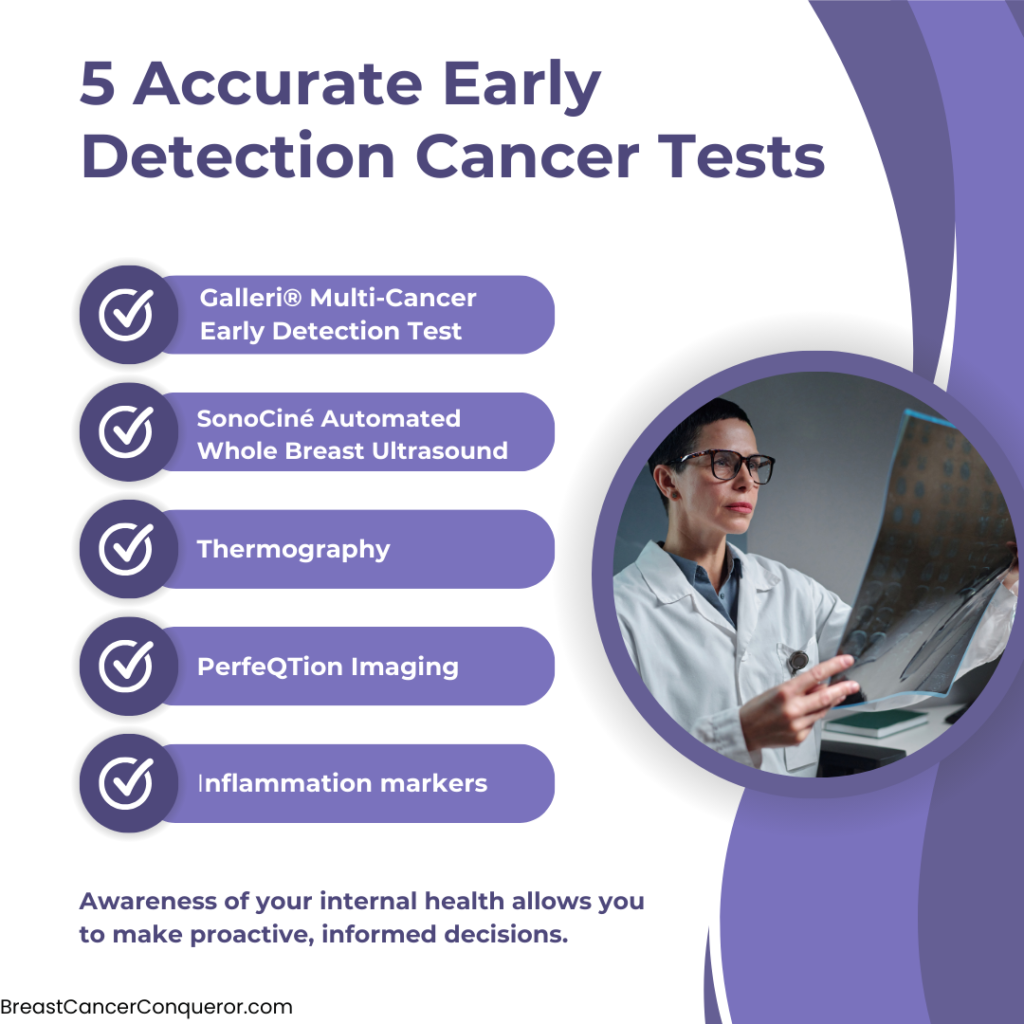
Awareness of your internal health allows you to make proactive, informed decisions. For more insight, please review Essential #7: Adopt Very Early Detection of the 7 Essentials System®. [5]
1. Galleri® Multi-Cancer Early Detection Test
The Galleri® Test is revolutionizing early detection.
- Screens for 50+ types of cancer
- Requires just one noninvasive, simple blood draw
- Detects cancer signals before symptoms appear
This is a powerful option for women who want a bigger-picture view of their cancer risk, beyond just breast tissue. Click here [6] for more details.
2. SonoCiné AWBUS (Automated Whole Breast Ultrasound)
For women with dense breasts or implants, this is a game-changer.
- Provides high-resolution imaging of breast tissue and lymph nodes (axilla)
- No radiation
- Much more effective than mammograms for dense tissue
This is especially important since dense breast tissue can mask tumors on mammograms, leading to missed diagnoses. Click here [7] for more details on SonoCiné AWBUS, and click here [2] for insights on decreasing dense breasts.
3. Thermography
Thermography looks at function, not structure.  [8]
[8]
- Detects heat patterns and blood flow changes
- Can identify abnormalities 6–8 years before a lump forms
- Completely non-invasive and radiation-free
Think of thermography as an early warning system, alerting you to imbalances and signs of breast cancer even 6-8 years before any palpable mass appears. For more insights into thermography, please read this blog post [9] and listen to this podcast episode [8].
4. PerfeQTion Imaging
This emerging technology is poised to transform breast imaging.
- Uses advanced soundwave technology
- Creates 3D, radiation-free scans
- Comfortable and fast
- May eventually replace mammograms, MRIs, and ultrasounds
Learn more about this test here. [10]
Advanced Testing for Personalized Treatment & Monitoring
If you’ve already been diagnosed, these tests provide powerful, personalized data on your progress and insight into your treatment’s effectiveness.
5. Onconomics Plus RGCC Test
This is where testing becomes truly individualized.
- Detects Circulating Tumor Stem Cells (CTSC)
- Identifies which natural and pharmaceutical therapies are most effective for YOU
- Provides personalized protocols on which natural and pharmaceutical substances would help your body the most
Uncover more info on RGCC tests via this blog post. [11]
6. Signatera™
A cutting-edge monitoring tool for your healing journey.
- Detects minimal residual disease (MRD)
- Can identify recurrence up to 6 months before imaging
- Evaluate the need for adjuvant chemotherapy after surgery
- Tracks whether cancer is shrinking, stable, or progressing
- Covered by Medicare for patients starting with stage IIB (2-5 cm tumor)
This empowers you and your practitioner to adjust your plan in real time.
The Future of Breast Cancer Detection: AI & Precision Medicine
Artificial intelligence is revolutionizing personalized and effective care. From surgery and pathology support to extremely early detection, AI treatment options can do a world of good for breast cancer thrivers.
Specifically, a few ways AI is now being integrated into cancer care:
- Analyze patterns faster and more accurately
- Predict treatment responses
- Support precision-based healing strategies
- Provide surgical precision
These innovations are helping shift the paradigm from reactive medicine to proactive, individualized care. To learn more about specific AI tools for breast cancer healing, including the Monicor [12] at The Karlfeldt Center, please review this blog post [13].
Test With An Expert. Don’t Stress & Guess.
You are not stuck with outdated options, and you are certainly not powerless. Take advantage of these testing options and partner with a Private Coach [14] to review your tests and curate a personalized action plan that is rooted in the 7 Essentials System®. [5] Answers are available. You just need to take the actions to get them.