Note: Expressive Writing Therapy is one way to process emotions and heal from trauma, but it is not the only way. Always talk to a mental health professional for personalized support.
Quick Read:
- “Emotional baggage” means the heaviness, fatigue, aches, and dis-ease that arise when unprocessed emotions quietly take up residence in your tissues, nervous system, immune system, and hormones.
- Expressive Writing Therapy, pioneered by psychologist James Pennebaker, is a therapeutic writing style that gives your body a way to metabolize emotion the same way detox pathways metabolize toxins.
- Expressive writing is about giving your body permission to stop holding what your heart has been carrying.
At Breast Cancer Conqueror, we teach that healing is not just about what you remove from your body: it’s also about what you release from your soul, emotions, mind, heart, and energy system.
Essential #4: Heal Your Emotional Wounds (of Dr. V’s 7 Essentials System® [1]) reminds us that emotions are not abstract or “just in your head.” Emotions are energy in motion, and when that energy gets stuck, suppressed, or ignored, it doesn’t disappear…it embeds itself into the body.
This is what people mean when they talk about emotional baggage. The heaviness, fatigue, aches, and dis-ease that arise when unprocessed emotions quietly take up residence in your tissues, nervous system, immune system, and hormones.
Unhealthy emotions can even impact your DNA and how your genes express themselves. This is why lowering stress and improving emotional health are not side notes in healing; they are central players.
Unresolved trauma, grief, fear, anger, and overwhelm directly influence:
- Your immune resilience
- Your hormonal balance
- Your inflammation levels
- How your DNA expresses itself
In other words, your emotional world is biologically powerful.
Which is why tools that help safely process and release emotional pain are essential for healing. We offer many options under Essential #4 [1], and today we are excited to share with you: Expressive Writing Therapy, pioneered by psychologist James Pennebaker.
This therapeutic writing style gives your body a way to metabolize emotion the same way detox pathways metabolize toxins. By moving what’s trapped out of your body, instead of letting it quietly sabotage your health from within.
This isn’t “Dear Diary” journaling. It’s a strategic, science-backed emotional detox.
What Is Expressive Writing Therapy?
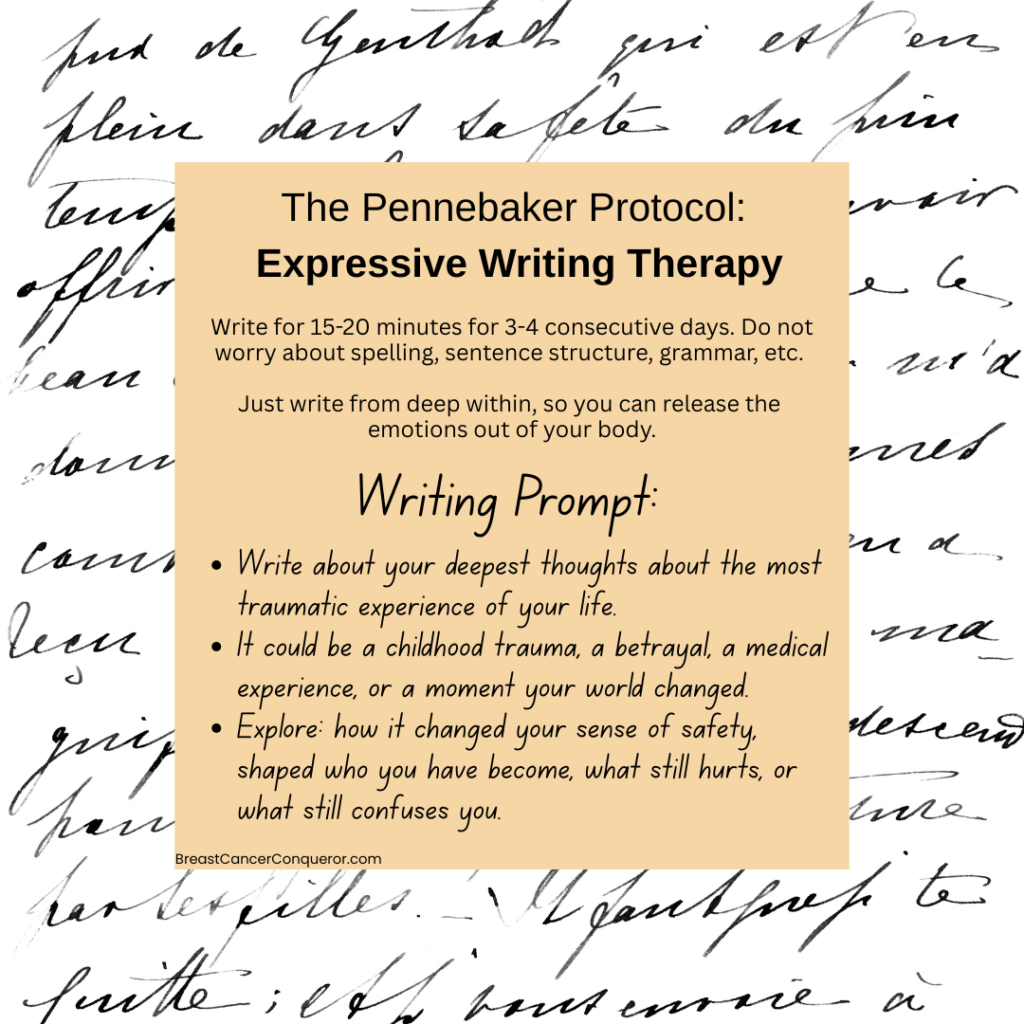
Expressive writing therapy is a structured emotional processing technique where individuals write about their deepest emotions and traumatic experiences for short, focused sessions. They typically last 15–20 minutes for 3–4 consecutive days.
James Pennebaker discovered that when people write openly about difficult experiences, it can lead to:
- Improved immune function
- Better sleep
- Fewer doctor visits
- Reduced anxiety and depression
- Improved cardiovascular health
- Better focus and memory
This is because “trapped trauma” can make someone feel heavy, less mobile, exhausted, and distracted. Cortisol spikes from chronic stress can also weaken your nervous system, immune system, hormones, and cellular communication.
The magic of expressive writing isn’t in beautiful sentences or poetic flow. It’s what happens neurologically and biologically when emotions become language and are transferred from your body onto paper. Doing so helps move the body from survival mode into a state of regulation and, therefore, healing.
Expressive Writing Integrates the Experience into a Narrative
Trauma lives in fragments: sensations, memories, fear responses. When you write about it, your brain begins to organize the experience into a story instead of a threat.
This reduces its intrusive power. In neuroscience terms: You move from reactivity → integration → resolution.
The resolution literally frees up mental bandwidth, allowing your brain to focus, problem-solve, and heal more efficiently. You may feel less foggy, overwhelmed, scattered, and emotionally exhausted.
The Pennebaker Protocol: Expressive Writing Therapy
Psychologist James Pennebaker created this exact formula in the 1980s. It’s based on his discovery that disclosing secrets and confronting traumatic experiences reduces emotional inhibition, leading to significant improvements in both physical and mental health.
There’s a science to it, and that’s what separates expressive writing from casual journaling.
Side note: We fully support all forms of creative writing, journaling, and anything that helps you process emotions in a healthy, healing way!
Here’s the Expressive Writing Therapy Pennebaker Protocol:
Time and Frequency
- Write for 15–20 minutes
- For 3–4 consecutive days
- The same time of day is ideal, but not required
Focus on Emotions
Don’t just describe what happened, write how it made you feel:
- Fear
- Anger
- Grief
- Confusion
- Betrayal
- Sadness
- Relief
- Hope
The emotional content is the medicine. Don’t hold back.
Unfiltered Writing
Ignore:
- Grammar
- Spelling
- Punctuation
- Structure
This is not for publication; it’s for release. Just write without a single worry about sentence structure.
Keep It Private
Write for yourself only. You do not need to share this with anyone unless you choose to.
Cognitive Integration
As you write, you may naturally begin connecting:
- Past events
- Relationships
- Patterns
- Beliefs
- Meaning
This is your brain healing itself. You may even tap into your subconscious and think about things you have chosen to forget or didn’t even know lived inside your body until now. Let those thoughts in and then write them out.
Pennebaker’s research showed that people who wrote about trauma and deep emotions experienced significantly more health benefits than those who wrote about superficial topics. We ALL have trauma stored in our bodies, and when it is released, our bodies can go back to using that energy for healing instead of holding on to the pain it’s carrying.

How It Relates to Breast Cancer Healing
A breast cancer diagnosis doesn’t just affect your body. Many women tell us that it impacts their:
- Identity
- Sense of safety
- Relationships (such as the ability to be a mother, wife, friend, and so forth)
- Future vision
- Career
- Trust in their body
And many women try to:
- “Stay strong”
- “Be positive”
- “Not burden others”
- “Keep it together”
But suppressed emotions don’t disappear. They relocate, and often into the immune system, hormones, and inflammation pathways.
Expressive writing becomes a way to:
- Process fear without drowning in it
- Release anger without hurting relationships
- Grieve losses that no one sees
- Reclaim your voice
- Reconnect with your power
Expressive Writing Therapy Prompts You Can Use
These are based directly on Pennebaker’s research and adapted for women like you who are navigating breast cancer and healing. You do NOT need to do all of them. Choose one and commit to 3–4 days of the Pennebaker Protocol.
Prompt 1: The Core “Deepest Thoughts” Prompt
This is the foundation of Pennebaker’s research.
For the next 4 days, write about your very deepest emotions and thoughts about the most traumatic or upsetting experience of your entire life.
This may or may not be your cancer diagnosis.
It could be:
- Childhood trauma
- A betrayal
- A loss
- A relationship
- A medical experience
- A moment your world changed
Expand It By Exploring:
- How does this experience connect to your relationships?
- How did it change your sense of safety?
- How it shaped who you became?
- What still hurts?
- What still confuses you?
You can:
- Write about the same topic each day.
- Or explore different painful experiences.
Remember: There is no “right way to do this.” Just write from deep within, and be brutally honest.
Prompt 2: The “Hidden or Secret” Prompt
Some of the most healing writing comes from what we’ve never said out loud.
Write about something that:
- Consumes your thoughts
- You avoid thinking about
- You’ve never shared
- You feel ashamed, angry, or guilty about
- You feel “shouldn’t” bother you — but does
This could include:
- Resentment toward your body
- Anger about your diagnosis
- Fear you’re afraid to voice
- Thoughts about your partner, doctors, or treatment
- Feeling unsupported or unseen
This is where deep healing often begins—because secrets cost energy. And releasing them gives you your energy back.
Prompt 3: The “Positive Growth” Shift
This prompt is powerful when the emotional weight feels overwhelming.
Write about: How has this traumatic experience (breast cancer or it could be anything else) changed you in positive ways?
You are NOT dismissing the pain. You are reclaiming your power.
Explore:
- How have you become stronger
- More aware
- More compassionate
- More boundaries
- More aligned
- More intentional
- More YOU
Growth does not erase pain, but it can transform your capabilities.
Prompt 4: The “Immediate Shift” (When You Feel Stuck)
If you find yourself frozen or emotionally blocked, try shifting perspective.
Write from:
- Your future self looking back
- Your younger self is witnessing this moment
- Your body speaking to you
- A loved one observing your journey
- The part of you that already knows how this story ends
Perspective changes everything—including you.
When your emotional world stabilizes, your biological terrain becomes far less hospitable to dis-eases.
Your Story Is Medicine
Healing is not just biochemical: it is deeply emotional, psychological, and spiritual.
Your story is not a burden, and your voice should be a navigating light in your healing journey.
Expressive writing is not about being dramatic or dwelling on things. It is about giving your body permission to stop holding what your heart has been carrying.
So that your body can finally exxhhhaaallleeee…