

Quick Read:
- Immunotherapy is a treatment designed to activate, restore, or enhance your immune system’s ability to detect and destroy cancer cells.
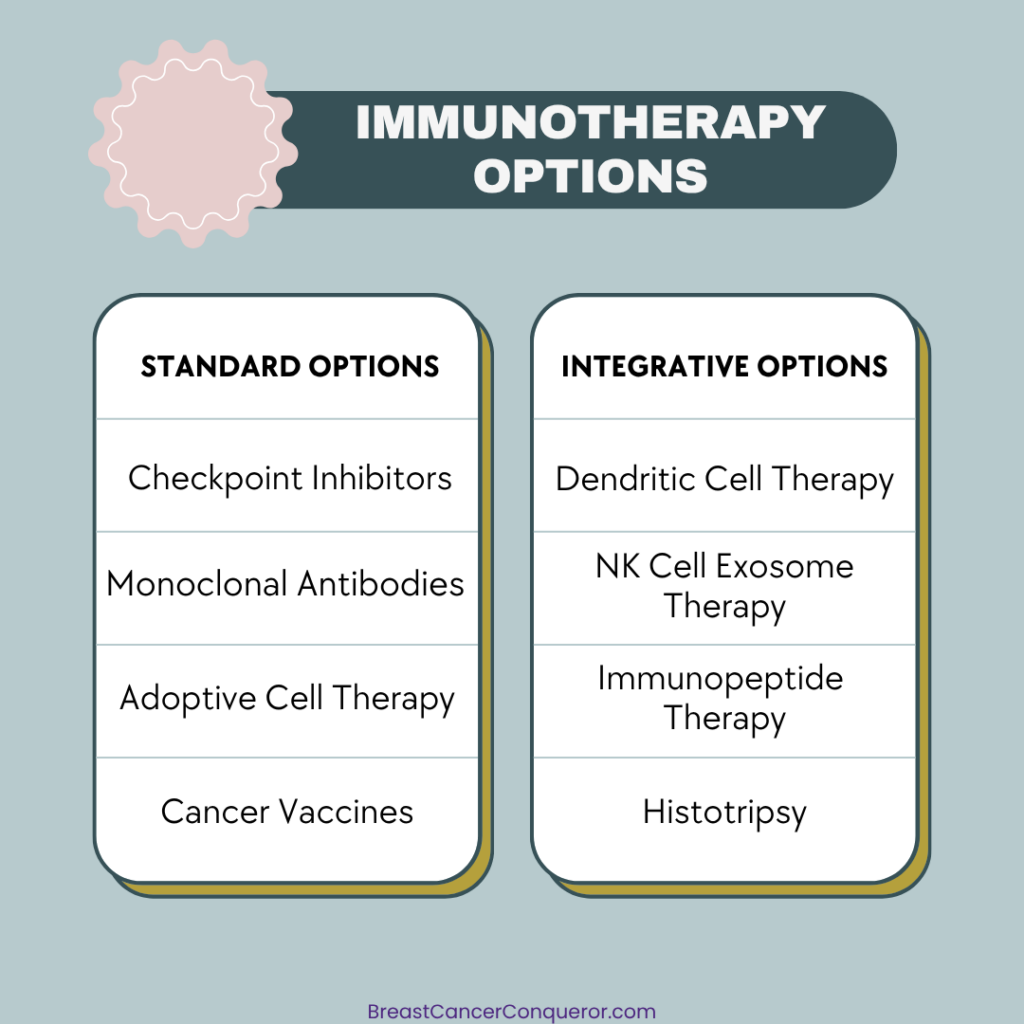
- Standard options include: Checkpoint inhibitors, monoclonal antibodies, adoptive cell therapy, and cancer vaccines.
- Integrative options include: Dendritic cell therapy, NK Cell Exosome Therapy, Immunopeptide Therapy, Histotripsy, and The Cancer BioShield™.
As we always say: YOU HAVE OPTIONS! You do not have to do ONLY chemo or only take supplements. In fact, this is why we are hosting Healing With Clarity to help you create a strategic healing plan with confidence. These days, you can curate a plan that gives you the best of all worlds and exactly what your body and mind need. One option could be a mix of immunotherapies, used either standalone or alongside your treatments.
Immunotherapy focuses on strengthening and guiding your immune system to better recognize and eliminate cancer cells. This is a profound shift in perspective. Your immune system was designed to protect you, and in many cases, it simply needs the right support and signals to do its job well again.
What Is Immunotherapy?
At its core, immunotherapy is a treatment designed to activate, restore, or enhance your immune system’s ability to detect and destroy cancer cells.
Every day, your immune system constantly scans for abnormal cells. However, cancer can disguise itself or suppress immune responses, allowing it to grow undetected. Immunotherapy helps “unmask” these cells and re-engage your body’s natural defenses to kill off cancer cells on its own.
While outcomes vary from person to person, immunotherapy may offer several advantages, as it enhances your body’s natural defenses, especially when used as part of a comprehensive healing strategy.
Key reasons to explore immunotherapy for breast cancer healing: (Study)
- More targeted action: Designed to focus on cancer cells while minimizing damage to healthy ones.
- Immune memory: Some therapies may help the immune system “remember” cancer cells, potentially reducing the risk of recurrence.
- Option for resistant cancers: May be effective when conventional treatments are no longer working.
- Synergy with integrative care and traditional treatments: It can be combined with nutrition, detoxification, emotional healing, and other therapies. Immunotherapy can also enhance the impact of traditional treatments (such as chemo and radiation) by making your body more receptive to them.
This is why immunotherapy is often explored not as a standalone solution, but as part of a personalized, whole-body approach to healing. The whole-body approach is also why Dr. V created the 7 Essentials System®, because as we said above, healing isn’t about chasing a single treatment. It requires creating a comprehensive plan that gives you a complete transformation of your mind, body, and soul.
Who Benefits The Most From Immunotherapy?
Immunotherapy is not a universal solution, but it can be incredibly powerful for certain women, especially when used strategically. While ongoing research is rapidly expanding its uses, at the moment, immunotherapy is most commonly used for:
- Triple-negative breast cancer (TNBC). Click here to unearth other helpful therapies.
- Women with metastatic or advanced-stage cancer.
- Those whose cancer has not responded to conventional treatments.
- Women with tumors that show high immune activity markers (like PD-L1 expression).
That being said, below are several innovative options of immunotherapies and other integrative therapies that could be an amazing tool for many women on a healing journey. If you are curious, make sure to discuss it with your medical team and private coach.
The Standard Types of Immunotherapy
While this field of medicine is ever evolving, below are some of the most common forms of immunotherapy, along with brief descriptions to help you feel more empowered as you explore your options. As always, below is general info. Please talk to your medical team and private coach before trying anything new.
Checkpoint Inhibitors
Your immune system has built-in “checkpoints” that prevent it from becoming overactive. Cancer cells can hijack these checkpoints, essentially telling your immune system not to attack. Checkpoint inhibitors block this signal, allowing your immune system to respond more aggressively. (Study)
Key points:
- Removes the “brakes” on immune cells, so your immune system can work better.
- Commonly used in advanced cancers and approved for more aggressive cancers such as TNBC. Click here to learn more via this study on the future of TNBC and immunotherapy.
Monoclonal Antibodies
These lab-created antibodies are designed to attach to specific markers on cancer cells. Once attached, they can either block growth signals or flag the cancer cell for destruction. (Study)
Key points:
- Inhibit tumor growth
- Deliver targeted therapies directly to cancer cells
- Help the immune system recognize cancer more clearly
Adoptive Cell Therapy (CAR-T and CAR-NK)
This is a more advanced approach where immune cells are removed, enhanced in a lab, and then returned to the body. (Study) It’s an emerging and exciting form of therapy, so keep an eye on it!
- CAR-T therapy: Uses engineered T-cells.
- CAR-NK therapy: Uses natural killer cells, often with fewer side effects. Please review this blog post on how natural killer cells (NK cells) are your body’s secret cancer warriors.
Key points:
- Highly personalized
- Powerful for aggressive or treatment-resistant cancers
Cancer Vaccines
Cancer vaccines are an emerging area of immunotherapy in breast cancer, and early research shows meaningful potential. (Study)
Key points:
- Targeted immune activation: Cancer vaccines are designed to train the immune system to recognize specific tumor antigens (such as HER2), helping the body identify and attack cancer cells more precisely.
- Stronger impact in early-stage or minimal disease: Vaccines may be more effective when tumor burden is low, such as after surgery or during remission, when they can support immune surveillance and reduce the risk of recurrence.
- Variable but promising outcomes: While results have been mixed in advanced breast cancer, ongoing trials are improving vaccine design and personalization. Like most things, they should be viewed as a promising complementary therapy rather than a standalone solution.
Advanced and Integrative Immunotherapy Options
Beyond conventional options, several innovative therapies are being explored in integrative oncology settings. Check them out with a curious eye, open heart, and with the guidance of your medical team and private coach. Many of these options are open to most women with breast cancer.
Dendritic Cell Therapy
Dendritic cells are often referred to as the “messengers” of the immune system. They play a critical role in presenting threats to immune cells and initiating a response.
In dendritic cell therapy, these cells are collected, exposed to tumor-specific information, and then reintroduced into the body to guide immune activation. It uses your blood cells and only targets the cancer cells, not your healthy ones.
Key points:
- Personalized immune targeting
- Support for metastatic or advanced cancers
- Ability to “teach” the immune system what to attack
- Helps treatments such as chemo be more effective
For more insight into dendritic cell therapy and how it works, please review this blog post.
NK Cell Exosome Therapy
NK cell exosomes are tiny but mighty vesicles that harness the natural power of your immune system’s “first responders”—Natural Killer cells. Natural Killer cells identify and eliminate cancerous and senescent (or “zombie”) cells, all without harming healing ones.
Key points:
- Targets cancer stem cells
- Enhances immune communication
- May improve immune surveillance
To discover more insights into NK Exosome Therapy, please listen to this podcast episode and read this blog post to uncover more info on NK Cells.
Immunopeptide Therapy
Immunopeptide therapy is tailored to your tumor biology, allowing for a more strategic and targeted immune response. It works by introducing small protein fragments (peptides) that mirror specific markers found on tumor cells, essentially “showing” your immune system what to target.
Key points:
- Works well in metastatic cases and when conventional options are limited
- Designed around your unique tumor markers for a more precise immune response
- Typically associated with mild, short-term side effects compared to more aggressive treatments
This is one of the many effective, safe, and reliable therapies that you can receive at The Karlfieldt Center in Idaho.
Cancer BioShield
The Cancer BioShield™ is a revolutionary multi-model approach to healing breast cancer. It’s designed to reverse immune collapse and empower the body to heal itself from the inside out.
It can be paired with Chemotherapy or Radiation to optimize their effects and minimize side effects, or serve as a powerful healing therapy on its own.
Key points:
- It uses 3 parts to offer a comprehensive, novel, immune-restoring therapeutic platform aimed not only at expanding effector immune cells but also at overcoming tumor-mediated immune suppression to support long-term disease control.
- It pairs well with Chemotherapy or Radiation to optimize their capabilities and minimize side effects.
For more details on The Cancer BioShield™, please review this blog post.
Histotripsy
Histotripsy is one of the most exciting emerging therapies because it bridges physical tumor destruction with immune activation. This non-invasive treatment uses focused ultrasound waves to mechanically break apart tumors, all without surgery, radiation, or heat.
It also looks as sci-fi as it works: A robotic arm delivers high-intensity ultrasound pulses, creating a “bubble cloud” that disintegrates tumor cells into liquid debris. The entire process is guided by real-time imaging, and the body slowly reabsorbs the liquified tumor. So far, it has targeted liver cancers with a 95.5% success rate, and its ability to target breast cancer tumors is evolving. (Study)
Key points:
- Provides effective and non-invasive tumor destruction
- Releases tumor fragments that may help stimulate a broader immune response against cancer
- Targets tumors while sparing surrounding healthy tissue
Is Immunotherapy Safe?
Immunotherapy is often perceived as gentler than conventional treatments, but it is still powerful and must be approached thoughtfully. Because it activates the immune system, side effects are often related to inflammation or immune overactivity.
Common side effects may include:
- Fatigue
- Skin reactions
- Digestive discomfort
- Flu-like symptoms
In some cases, more serious immune reactions can occur, such as:
- Autoimmune-like inflammation
- Organ-specific immune responses
This is why testing, monitoring, and doing so only under the guidance of your medical team and private coach are essential.
Support the System That Heals You
Immunotherapy represents a powerful shift in cancer care, one that honors your body’s intelligence and ability to heal rather than overriding it. It’s opening up the conversation from a single-treatment focus to creating an internal terrain where true, transformational healing is possible.
If you are exploring immunotherapy and want guidance rooted in the 7 Essentials System®, working with a knowledgeable and compassionate private coach can help you navigate your options with clarity and confidence. We are here for you, every guided step of the way!