
Quick Read:
- Influencers are excellent storytellers: they know how to tug at your heartstrings, are confident, and look healthy and vibrant. And they speak in absolutes, the thing your brains crave when we’re overwhelmed and scared.
- Learn the difference between the types of studies and how to find the credible ones.
- Avoid people using pressure tactics, fake endorsements, and one-size-fits-all and cure-all types of messaging. Also, remember that “all-natural” is a vague and unregulated word.
If you scroll Instagram, flip around TikTok, or get lost in YouTube, you know what we are talking about. And it’s honestly easy to want to believe that a new therapy, a creative way of using a product, or a super supplement will make all the difference. You want to heal, we want you to heal, and so does your entire world…which is why sometimes it’s easy to fall into their traps.
Those compelling reels, confident voices, bold claims, and beautiful “all-natural” videos are speaking to you—but should you listen?
And while the desire for answers (real answers!) is completely understandable, not everything trending online deserves a place in your healing journey. In fact, some of it can do real harm.
This blog isn’t about fear, shame, or dismissing curiosity. It’s about learning how to think critically, evaluate research wisely, and make informed decisions that support your body so you don’t go chasing the latest viral “cure-all for everyone.”
Why Social Media Hype Is So Convincing
Influencers are excellent storytellers: they know how to tug at your heartstrings, are confident, and look healthy and vibrant. And they speak in absolutes, the thing your brains crave when we’re overwhelmed and scared.
But confidence does not equal credibility.
Healing is complex, and cancer biology is nuanced. And no single supplement, patch, protocol, or trend works universally for everyone—and sometimes they don’t work for anyone. That’s why hype-based healing is dangerous. It oversimplifies something that requires personalization, testing, and context.
The Nicotine Patch
For example, some influencers have begun promoting nicotine patches as a cancer-supportive therapy.
A simplified version of the reasoning usually goes like this:
- Nicotine interacts with certain receptors
- Those receptors may influence inflammation
- Therefore, nicotine must be “anti-cancer”
Now, let’s look at this with a critical, 7 Essentials System® eye:
While it’s true that nicotine has been studied in laboratory settings for its interaction with specific cellular pathways, the broader body of research tells a very different story.
Nicotine has also been shown to:
- Increase angiogenesis (the formation of new blood vessels that tumors use to grow)
- Activate cancer cell survival pathways
- Reduce chemo sensitivity
- Stimulate estrogen-related pathways
- Promote tumor growth and progression in multiple cancer models
So while a single mechanism might sound promising when isolated, the totality of evidence paints a much more concerning picture. This is why we suggest extreme caution if you are considering using a nicotine patch as a cancer-supportive therapy. Not everything that reduces inflammation is safe for cancer. Not everything that sounds “biohacker-approved” belongs in healing.
Understanding the Types of Research (and Their Limits)
Research is valuable, but you should also know the type of research you are reviewing to put it in context. Let’s go over it:
In Vitro Studies (Lab Studies)
These are done on cells in a dish.
- Helpful for early exploration
- Useful for understanding mechanisms
However, while they are valuable and informative, they do NOT replicate the complexity of the human body. Therefore, do not replace clinical judgment, lived experience, or additional testing.
For example, while we are big fans of RGCC Tests, we are clear that they are done in vitro. Which means they should provide guidance, but not be seen as an absolute answer. It’s also why we ALWAYS recommend backing up a test with a different type of one. In-vitro data can be fascinating and useful, as long as it’s placed in its proper context.
Animal Studies
These are done in mice or other animals.
- Helpful stepping stones
- Provide more context than lab studies
Still, animals are not humans who are interacting with their world, eating certain foods, trying to manage stress, juggling family life, breathing in toxins, taking medications, and so forth.
Human Clinical Studies
These involve real people.
- Most relevant to actual outcomes
- Consider absorption, metabolism, and safety
- Account for side effects and long-term impact
This is the gold standard, but still not perfect because it doesn’t specifically account for your lifestyle and needs.
Peer Review and Reproducibility Matter
One study does not equal proof. You never know who could have “paid” for the study and therefore the results. This is why finding multiple studies from credible sources is critical.
When evaluating a claim, ask:
- Has this research been peer-reviewed?
- Are there multiple studies showing similar results?
- Are conclusions cautious, or wildly overstated?
- Who funded the study?
- Does the data seem cherry-picked?
- Are risks ignored?
- Are the conclusions exaggerated?
Red Flags to Watch for in “Hype Healing”
Another way to determine whether the new product, tool, or therapy is worth it is to assess these red flags.
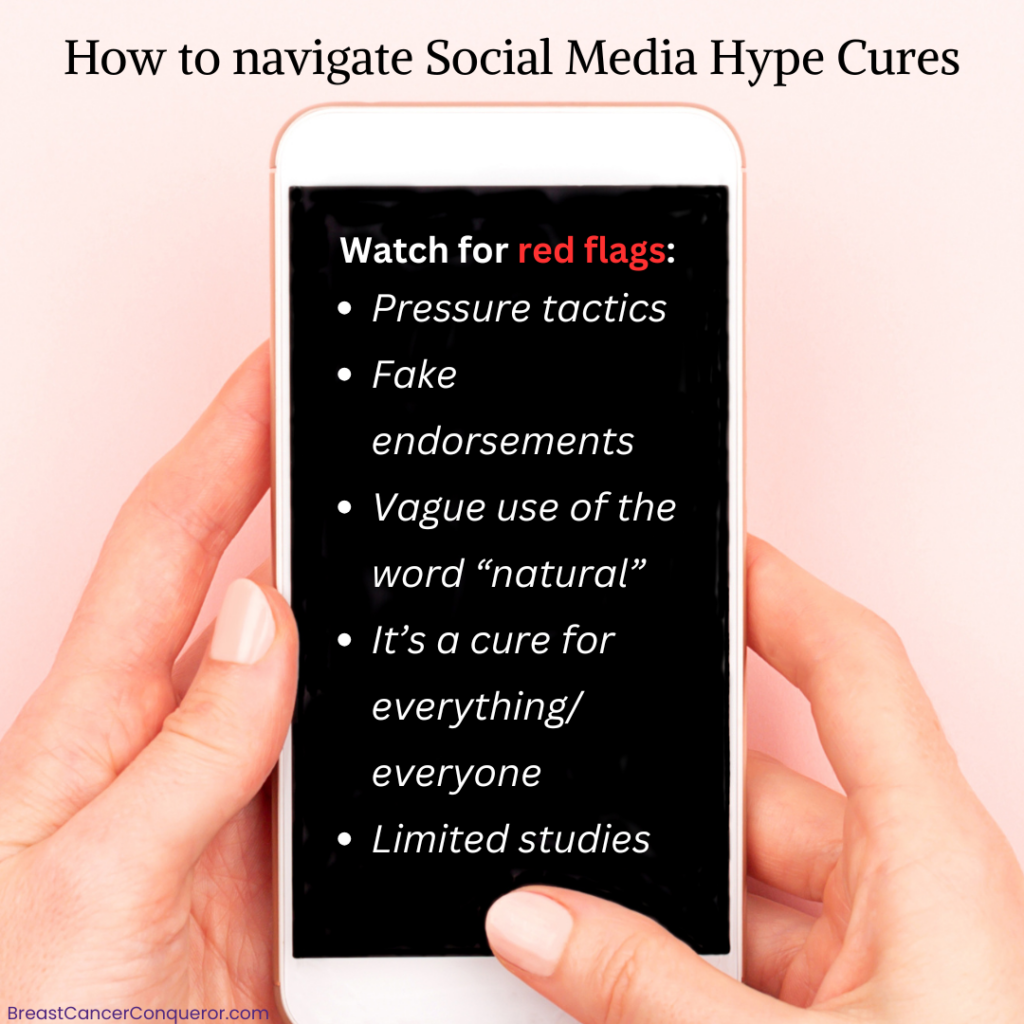
Here are a few warning signs that something deserves skepticism:
Pressure Tactics
“If you don’t act now…”
“Limited supply…”
“This will be banned…”
Healing tools should never be a “panic buy.”
Phony Endorsements
Unverifiable “doctor testimonials,” vague credentials, and anonymous success stories. Real science doesn’t hide its sources, and neither do credible medical professionals. Anyone can buy a white coat. Make sure they have the resume to back it up.
“Natural” Does NOT Always Equal Safe
While we are big advocates of incorporating natural therapies into your healing, “natural” is a vague term that is not regulated, and people can use it for anything.
For example, “natural substances” can still negatively interfere with medications, activate cancer pathways, and put stress on your liver or kidneys. Always talk to your medical team and Private Coach before trying something new.
One-Size-Fits-All Protocols
If it worked for one person, that’s interesting. If it’s presented as a universal solution, that’s a problem. What may work for someone (keep in mind they could be exaggerating or even lying to make money) may not work for you. Again, this is why working with a Private Coach and staying in constant contact with your medical team can bring clarity to your journey.
Why Personalization Is Always the Best Policy
Your tumor biology, hormone status, detox pathways, microbiome, nutrient levels, and stress response are unique. That’s why copying someone else’s protocol, no matter how convincing, is rarely effective and sometimes harmful.
The smartest approach is a balanced and personalized one:
- Use testing as information, not fear
- Combine data with professional guidance
- Reassess and adjust as your body changes
- Stay curious, but grounded
These days, there are dozens of personalized tests that you can take advantage of to detect, monitor, and understand your body. Essential #7: Adopt Very Early Detection provides a list of tests that you can use, but you should always back them up with another test to compare data.
Because true healing can happen when you have clarity about doing the right things for you.
Healing With Clarity Virtual Retreat in May
May 11-13, we are hosting: Healing With Clarity — What to Use, What to Test, and Why. This virtual retreat was created to address a deeper problem many women face in healing: Too much information. Not enough personalized clarity. The guessing, stressing, and falling for hyped-up cures is such a common issue that we decided to take action and turn your questions into a virtual retreat brimming with answers and insights.
This retreat will empower you to:
✔ Understand which supplements actually matter for you
✔ Use testing without fear or overwhelm
✔ Stop copying protocols that aren’t personalized
✔ Make grounded, informed decisions
Join Head Coach De’Ann and pioneer in integrative oncology, Dr. Karlfeldt, as well as a list of world-renowned experts for balanced, science-backed, and strategy-based insight to help create your own personalized plans of action.
Be Curious But Not Reactive
We are certainly not telling you to reject every new idea. After all, that’s where every therapy, supplement, and treatment started at one point. But we are empowering you to be discerning, so you do not blindly accept new ideas and products.
When you learn how to evaluate research, question hype, and prioritize personalization, you step out of fear-based healing and into empowered decision-making.
Because the goal is to be a place where transformation begins, so you Never Fear Breast Cancer Again!
Lastly, feel free to reach out to us with any questions, concerns, thoughts, or ideas. We are here for you, and no judgment will ever be passed. Let’s talk through it, together: support@breastcancerconqueror.com