
Quick Read:
- The placebo effect involves real biological processes in the brain, nervous system, and immune system.
- A landmark review recently found that psychological stress and emotional distress can influence immune activity and inflammatory processes involved in cancer progression.
- Nocebo effect: when a person experiences harmful symptoms or worsening health simply because they expect something negative to happen.
The placebo effect: the remarkable phenomenon where belief alone can produce measurable changes in the body. Modern research has been providing endless evidence that placebo responses are far from imaginary. They involve real biological processes in the brain, nervous system, and immune system.
Understanding the placebo effect doesn’t mean ignoring science or abandoning evidence-based care. Instead, it highlights something powerful: your mind, emotions, and beliefs can influence the biological environment inside your body. Even more, it can increase the effectiveness of therapies, medications, supplements, etc.
Dr. Joe Dispenza’s book, You Are The Placebo, says, “If you begin the inner journey and start to change your inner world of thoughts and feelings, it can [eventually] create an improved state of well-being. If you keep repeating the process in meditation, then in time, epigenetic changes should begin to alter your outer presentation—and you become your own placebo.”
The Placebo Effect can help with your healing if you 100% believe in it, do the work, and pair it with the therapies, lifestyle changes, medications, supplements, stress management, and other protocols prescribed by your medical team and Private Coach.
What Science Says About the Placebo Effect
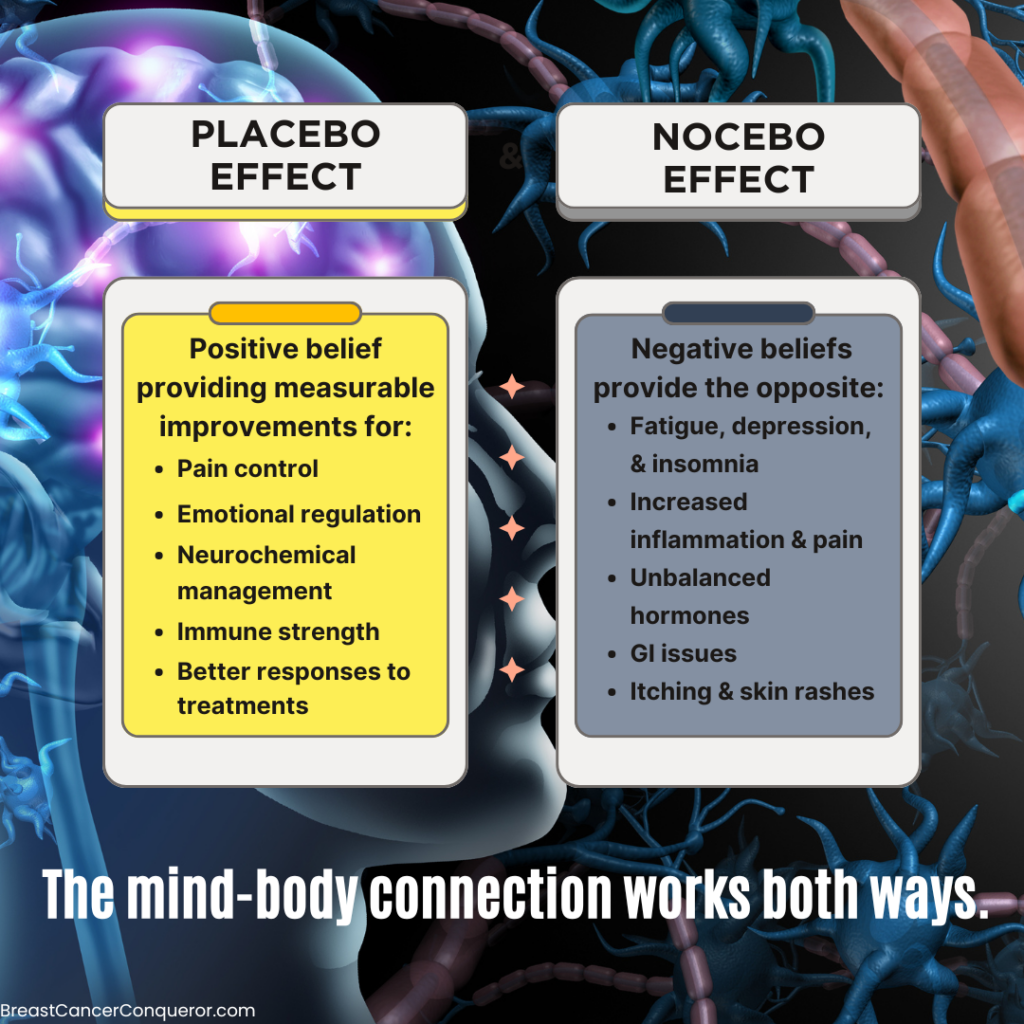
The placebo effect occurs when the body responds positively to a treatment because the brain expects it to work. That expectation can trigger measurable physiological responses. Studies show that placebo responses can activate brain regions responsible for:
- Pain control: Placebo effects reduce activation in pain-related brain networks (anterior cingulate cortex, insula, thalamus, and periaqueductal gray).
- Emotional regulation: Placebos modulate prefrontal-subcortical systems, reducing anxiety and fear associated with pain by impacting the amygdala and striatum.
- Neurochemical Management: Placebo responses involve the release of neurotransmitters, including dopamine, oxytocin, and other neurochemicals that influence inflammation, mood, and stress pathways.
- Immune strength: Placebo responses are associated with changes in immune-related signaling molecules, showing that belief can influence communication between the brain and immune system.
This research reinforces what integrative medicine has long suggested: the brain and body constantly communicate.
Psychoneuroimmunology: The Science of Mind-Body Healing
To better understand why the placebo effect works, scientists (and your team at Breast Cancer Conqueror!) often turn to the field of psychoneuroimmunology.
Psychoneuroimmunology examines how psychological processes interact with the nervous system and immune system. In simple terms, it studies how emotions, thoughts, and stress levels directly influence tumor biology, treatment outcomes, and cancer survival.
A landmark review titled Psychoneuroimmunology and Cancer: A Decade of Discovery found that psychological stress and emotional distress can influence immune activity and inflammatory processes involved in cancer progression.
Specifically, researchers reported several important observations:
- Chronic stress can alter immune cell activity.
- Depression and social isolation are associated with dysregulated immune responses.
- Emotional distress may influence inflammatory signaling pathways.
- The placebo effect triggers physiological changes, such as modifying cytokine levels or activating endogenous opioid systems, which can complement traditional cancer therapies.
Additionally, in women with breast cancer, studies have also found that higher levels of perceived stress and loneliness are associated with alterations in immune cell function and inflammatory cytokines.
These findings highlight an important reality: emotional health is not separate from physical health. Your thoughts, emotions, and stress levels can influence hormonal balance, immune signaling, and inflammation—all factors that play a role in healing.
Keep things in perspective.
While research has shown that The Placebo Effect can reduce pain, fatigue, anxiety, depression, and insomnia, all while improving the immune and nervous systems, it does have limitations. For example, a 2022 meta-analysis of oncology trials found that tumor responses in placebo groups were extremely rare, occurring in fewer than 2% of cases.
It’s obvious, but we still want to make clear: belief alone is not a cure for cancer, but it can certainly help make things better. This is because belief can support the body’s healing environment, improve resilience, reduce stress hormones, and improve quality of life during treatment.
The Nocebo Effect: When Negative Expectations Harm Health
Just as positive beliefs can support healing through the placebo effect, negative expectations can have the opposite impact. This phenomenon is known as the nocebo effect: when a person experiences harmful symptoms or worsening health simply because they expect something negative to happen.
For example, this study found that patients in placebo groups of cancer drug trials frequently reported significant side effects, including fatigue and gastrointestinal symptoms. The symptoms occurred purely due to expectation and psychological anticipation of harm.
Another 2022 review explained that negative expectations can activate stress pathways in the brain, increasing anxiety and triggering physiological responses that influence pain perception, inflammation, and hormone levels.
In other words, the mind-body connection works both ways.
If positive expectations can support healing, fear-based thinking and chronic worry may create biological stress responses that make symptoms feel worse. It truly is important to intentionally protect your mental and emotional state during a healing journey…and all the time!
Reducing exposure to fear-based information, surrounding yourself with supportive people, and focusing on solutions rather than worst-case scenarios can help minimize the nocebo effect.
The Daily Practice of Mind-Body Healing
While belief alone is not a replacement for medical care, cultivating a healing mindset can be a meaningful and powerful part of your daily routine.
The core idea is simple: your body already contains the biological systems needed for repair and recovery. But those systems function best when the nervous system is calm, balanced, and not overwhelmed by chronic stress. Creating space each day to slow down, quiet your mind, and reconnect with your body may help activate those healing pathways. Even setting aside 30 minutes per day for mind-body practices can help shift your nervous system toward a more restorative state.
Emotional Freedom Technique (Tapping)
This technique combines elements of acupressure, focused awareness, and verbal affirmations. Practitioners gently tap specific acupuncture points while acknowledging emotions or stressors. Like meditation, it can happen anywhere, at any time, and is totally free!
This 2019 study found that tapping improves multiple physiological markers of health, and this 2025 study shows it can help alleviate anticipatory grief in people with cancer. By calming the stress response, techniques like EFT may help the body shift toward a more balanced physiological state.
For more information and to learn how to tap, please watch the video of Dr. V below, read this blog post, and listen to this podcast episode.
Journaling and Expressive Writing
Writing about your thoughts and emotions can also be a powerful healing practice.
Expressive writing has been shown to help individuals process emotional experiences and reduce psychological distress. A 2018 study found that women with breast cancer who practiced expressive writing experienced improvements in emotional well-being and reduced intrusive thoughts.
Journaling allows you to externalize your thoughts, reshape your narrative, and reinforce beliefs about healing and resilience. Whether you write a paragraph, a gratitude list, or a poem, the act of putting your thoughts on paper can help shift your mental landscape.
For a guided practice, please review this blog post.
Cultivating Optimism and Gratitude
Optimism is more than simply “thinking positively.” It is a mindset that views challenges as temporary and solvable. For example, this study found that optimism is associated with lower inflammation and improved cardiovascular health. This study suggests that gratitude practices can reduce stress and improve psychological resilience.
A simple daily exercise can make a difference. Each morning and evening, take a moment to acknowledge two things you are grateful for. This small practice helps shift attention away from fear and toward appreciation, an emotional state associated with lower stress hormones.
Meditation
Meditation has been widely studied for its ability to reduce stress and improve emotional resilience.
A 2017 systematic review published in Psycho-Oncology found that meditation-based interventions significantly reduced:
- Anxiety
- Depression
- Psychological stress
- Fatigue
- Fear of cancer recurrence
Meditation works by calming the sympathetic “fight-or-flight” response and activating the parasympathetic nervous system—the body’s rest-and-repair mode. This shift can lower cortisol levels, reduce inflammation, and support immune balance.
To learn more, please listen to this podcast episode with Dr. V and review our guide to meditation tips and ideas.
Actively Participate in YOUR Healing
True transformational healing will not come from a single therapy or intervention. One thing did not cause the cancer, and one thing will not heal it. Instead, it is the cumulative effect of many factors working together. Nutrition, detoxification, immune support, hormonal balance, emotional healing, and lifestyle choices all play important roles. And all of those things you DO have control over!
The placebo effect reminds us that our minds are part of that equation. Your thoughts, emotions, and beliefs influence the nervous system and immune system in ways researchers are still working to understand.
But one thing we do know for sure: You are not powerless in your healing journey.
By combining evidence-based therapies with daily mind-body practices, you can create an internal environment that supports resilience, balance, and hope. And that is one of the most powerful foundations for healing. May you never fear breast cancer again!